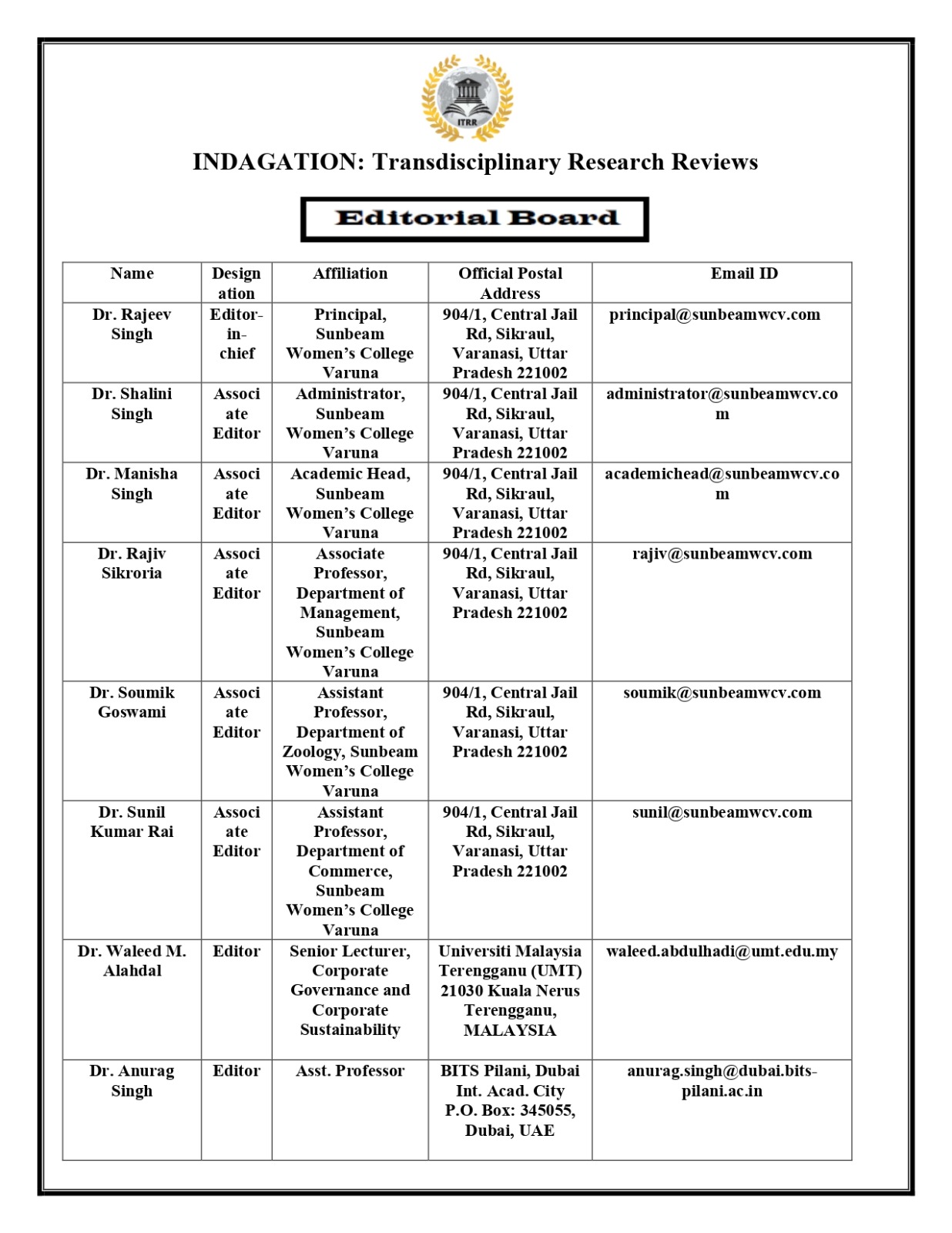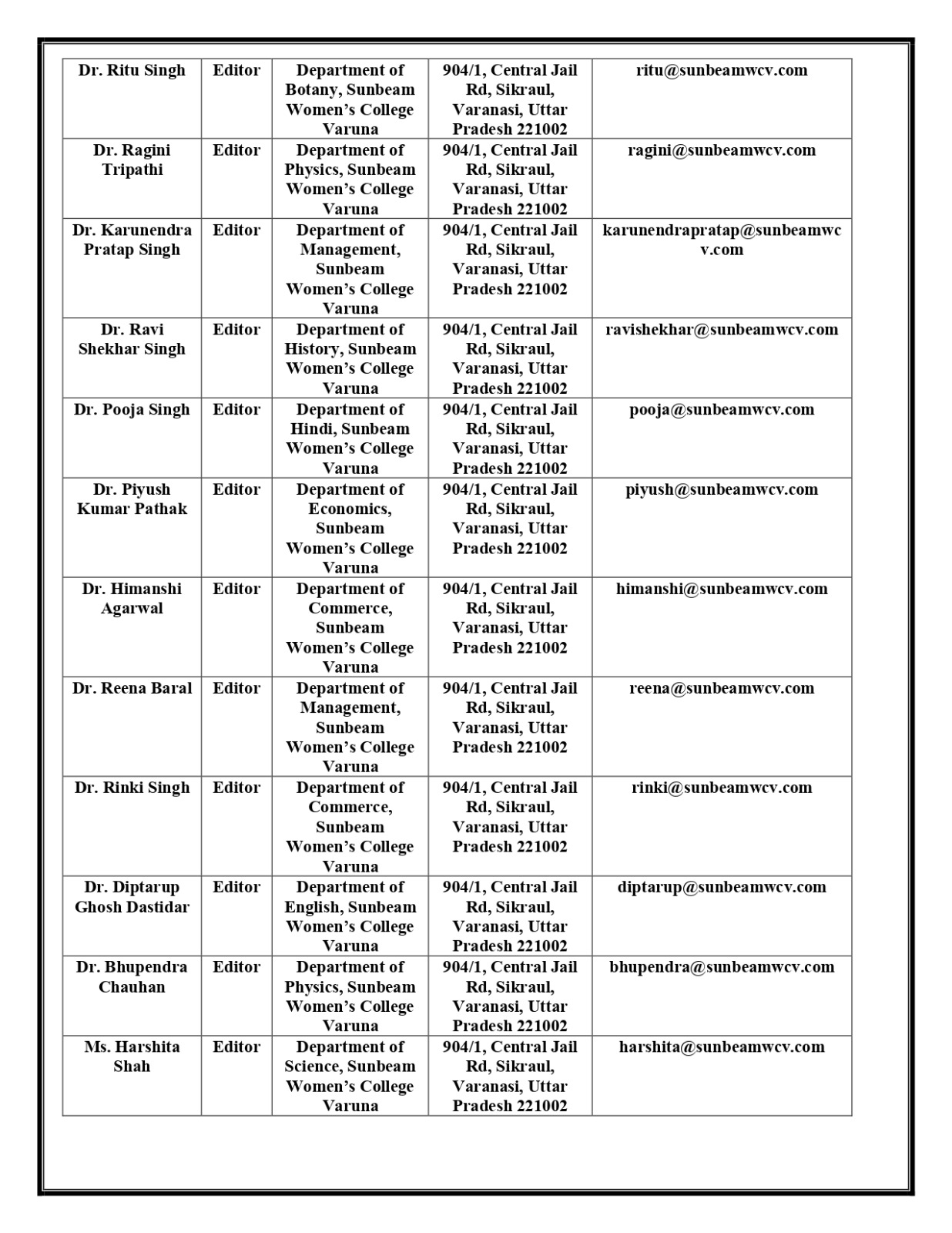
INDAGATION : TRANSDISCIPLINARY RESEARCH REVIEWS
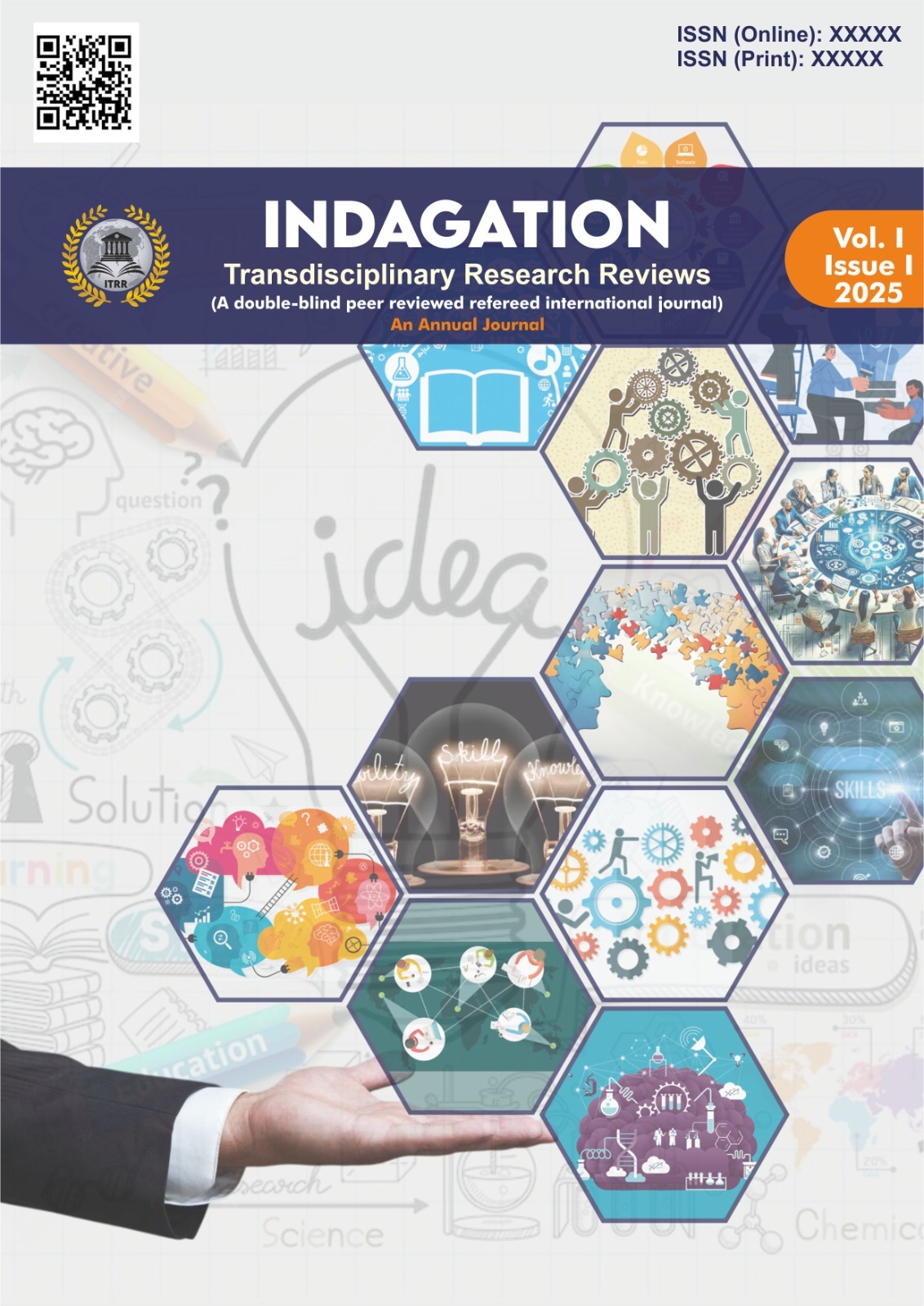
| Indagation: Transdisciplinary Research Reviews | |
|---|---|
| Starting Year of Publication | 2025 |
| Frequency of Publication | Annual |
| Format of Publication | Electronic (Online) |
| Subject | Multidisciplinary |
| Language | English and Hindi |
| Publisher Name | Sunbeam Women’s College Varuna |
| Publisher Address | 904/1, Central Jail Road, Sikraul, Varanasi – 221002, Uttar Pradesh, India |
| Contact Us (for any query) | Editor.itrr@sunbeamwcv.com |
About INDAGATION: Transdisciplinary Research Reviews (ITRR)
INDAGATION: Transdisciplinary Research Reviews (ITRR) is an annual premier open-access publication dedicated to fostering academic excellence by providing a global platform for researchers, academicians, and students. ITRR publishes high-quality, peer-reviewed research across multiple disciplines, including life sciences, health sciences, physical sciences, earth sciences, chemical sciences, library and information sciences, education, humanities, language sciences, social sciences, management, and engineering. Committed to upholding the highest research standards, ITRR exclusively accepts original, unpublished work, ensuring the integrity and novelty of published manuscripts. Submissions undergo rigorous plagiarism detection using advanced tools and a double-blind peer review process before publication. By facilitating seamless knowledge exchange, ITRR contributes tothe advancement of research and critical innovation worldwide.
Open Access Policy
As an open-access journal, ITRR ensures that all published content is freely available without any charges to users or institutions. Readers may access, download, copy, distribute, print, search, or link to the full texts of articles without requiring prior permission from the publisher or authors, in alignment with the Budapest Open Access Initiative (BOAI) definition of open access.
Aims and Objectives of ITRR
Aims:
• To establish ITRR as a leading open-access journal that promotes scholarly research across a broad spectrum of disciplines.
• To encourage the exchange of innovative ideas and original research findings among scholars, educators, and professionals worldwide.
• To maintain the highest standards of academic integrity through meticulous peer review and ethical publishing practices.
• To bridge gaps between various fields of study by fostering interdisciplinary research and collaboration.
• To contribute to global academic progress by providing a platform for the dissemination of groundbreaking research.
Objectives:
• To publish novel, high-quality research that enhances knowledge and understanding in various academic domains.
• To implement a strict plagiarism-checking system and comprehensive peer evaluation to ensure research authenticity and reliability.
• To provide unrestricted access to published content, enabling researchers and institutions to freely utilize academic findings.
• To cover diverse subject areas, including life sciences, health sciences, physical sciences, earth sciences, chemical sciences, library and information sciences, education, humanities, language sciences, social sciences, management, and engineering.
• To promote cross-disciplinary research that integrates different academic perspectives
for a more holistic approach to problem-solving.
• To support the global academic community by facilitating efficient and ethical dissemination of research discoveries. ITRR remains dedicated to fostering a high-quality research environment, enabling scholars to
share impactful discoveries and contribute to global scientific progress.
Submission Guidelines – INDAGATION: Transdisciplinary Research Reviews (ITRR)
1. Manuscript Requirements
A. Originality and Ethical Standards
• Submitted manuscripts must be original, previously unpublished, and not under
review elsewhere.
• The work must comply with ethical research standards and acknowledge sources
appropriately.
• Plagiarism, self-plagiarism, or any form of academic misconduct will result in
immediate rejection.
B. Manuscript Format and Structure
• File Format: Submit manuscripts in Microsoft Word (.docx/.doc) format.
• Language: The journal invites papers in multiple languages, with clear and concise
writing.
• Word Count:
o Research Articles: 3,000 – 8,000 words
o Review Papers: 4,000 – 10,000 words
o Short Communications: 1,500 – 3,000 words
C. Manuscript Sections
Submission may adhere to the structured format below for a clarity on the format preferred for
publication. However, authors are encouraged to use any structural format that aids the
presentation of their research.
1. Title Page
• Title of the manuscript (concise, informative, and reflective of the research content).
• Full name(s) of the author(s) with institutional affiliation(s) and contact details.
• Corresponding author’s email address.
2. Abstract (150-250 words)
• A summary of the study, including objectives, methodology, key findings, and
conclusions.
• Should not contain references or abbreviations.
3. Keywords (6-10 words)
• Relevant terms representing the core focus of the research